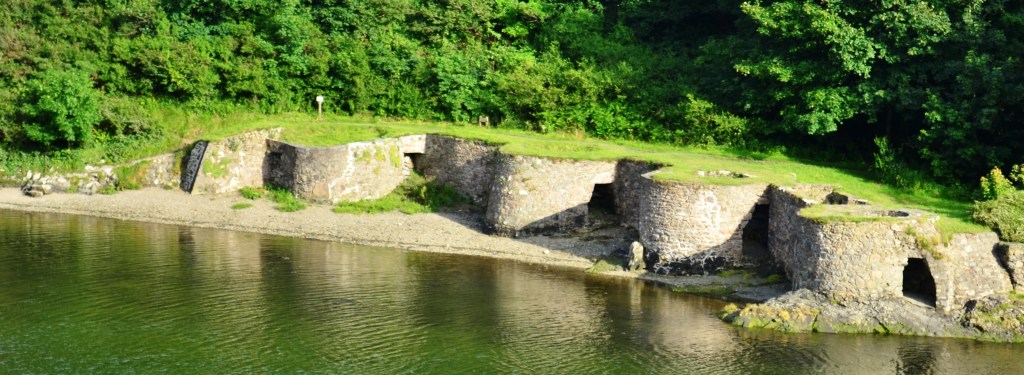
Dewisland, the area of Pembrokeshire in which Solva is situated, contains acidic soils. Since the 15th century or so, its fields have been treated with quicklime, an alkali that reduces acidity and makes the land more amenable to crop-growing. Other means of increasing soil productivity were used, including the spreading of seaweed or the mixing in of sand (the ‘Sand Quay’ in Solva harbour was the landing place for the latter material), but limestone became the principal method for obtaining quicklime.
Limestone rock was obtained from the south of the county – in particular, from the quarries around West Williamston and Pembroke town itself. It was transported by sea to Solva – and to most of the other small ports and inlets around the Pembrokeshire coast – together with culm, a mixture of coal dust and clay (so-called ‘small coal’). The culm was obtained locally from Nolton, Little Haven and later Hook – and from the Cleddau area generally. The limestone was broken up into small boulders, perhaps 15cm diameter, and loaded onto a small coal fire that had been started within the lime kiln for burning. Limestone is a calcium carbonate rock and in this burning process it would give off carbon dioxide, which has an extremely offensive smell, leaving calcium oxide, or ‘quicklime’. This would be transported by horse and cart to the surrounding ploughed fields where it would react with rain and form slaked lime, giving off a great deal of heat in the process but improving soil productivity. This chemical reaction is the reason why the ‘burning’ was carried out as close as possible to the place of use.
Widespread lime-burning is recorded at the end of the 17th century, and at its peak Solva had ten kilns in use. There are still four on the east side of the harbour, together with an outline of the burner’s shelter; one large kiln at the south end of the Gamlyn in the centre of the lower village; and two more at the northern end. There were also two others at the present Main Street roadside in front of the old chapel, and one in the garden area of the Harbour Inn.
 Home
Home 